
Pakistani intelligence is involved in marketing counterfeit currency in India and Bangladesh to patronise militant groups like Lashkar-e-Tayiba for their cross-border operations, a media report in Dhaka claimed on Saturday.

The list in 2018 contained about 7,600 names. It has been reduced to under 3,800 in the past 18 months, according to Castellum.AI, a New York-based regulatory technology company. About 1,800 of the names have been removed since the beginning of March, according to data collected by Castellum.
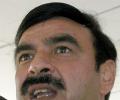
Pakistanis are well aware of Sheikh Rasheed Ahmed's patronage and facilitation of groups linked to armed resistance in Kashmir, says Amir Mir
An NIA official, who was part of the team that interrogated David Headley in FBI custody, tells Vicky Nanjappa that the Pakistani-American terrorist was beaming with pride each time they asked him about his association with the Lashkar and also his role in the 26/11 attacks.
Lawyers defending seven Pakistani suspects, including Lashkar-e-Tayiba commander Zakiur Rehman Lakhvi, in the Mumbai attacks case, on Saturday contended that the report of judicial commission that visited India should not be made part of their trial as it had "no legal value".
The United States has asked Pakistan's interior ministry to conduct a probe into Pakistani jihadis, including Lashkar-e-Tayiba operatives, joining militant groups in Afghanistan to attack North Atlantic Treaty Organisation and allied forces, a media report said on Tuesday.
Pakistani human rights activists on Thursday supported the decision by a special court in Mumbai to award the death sentence to Ajmal Kasab, the lone terrorist arrested during the terror siege on Mumbai in November, 2008. Pakistani human rights activist Marvi Sarmad said, "The decision to hang Ajmal Kasab is a right one; he deserved it. I will say that is a right decision, which was decided after a genuine process. I am personally against capital punishment."
Speaking at a hearing of the Foreign Relations Committee, Maryland Democrat Ben Cardin, a member of the Senate Foreign Relations Committee, said: "There are mixed signals here that are very, very troubling and that the United States needs to be able to have alternatives for carrying out its foreign policy in that region."

Headley also said that LeT boss Hafiz Saeed, the mastermind behind the November 2008 attack that killed 166 persons, motivated him for carrying out a 'jihad'. Saeed told him that the satisfaction of one second of 'jihad' is equal to "100 years of worship."
A Pakistani court has approved a plea to send the records of the trial of seven suspects, including Lashkar-e-Tayiba commander Zakiur Rehman Lakhvi, charged with involvement in the 2008 Mumbai attacks along with a judicial commission that is set to visit India to interview key officials.

A recent ProPublica investigation termed Pakistani-American Lashkar-e-Tayiba operative and 26/11 accused David Coleman Headley as a double agent working for both the American Central Intelligence Agency and the Pakistani Inter Services Intelligence.
Bangladesh has handed over three suspected Lashkar-e-Tayiba operatives to Pakistan, a year after they were arrested on suspicion of plotting attacks on Indian and American embassies in Dhaka, officials said.
Jamaat-ud-Dawah chief Hafiz Muhammad Saeed may face fresh detention after British diplomats met senior Pakistani officials to convince them to crack down on the organisation, a front for the banned Lashkar-e-Tayiba. Diplomats from the British missions in Islamabad and New Delhi had a "successful rounds of talks with Pakistani leaders in the last week of July".These talks "might lead to the detention of JuD chief Hafiz Muhammad Saeed.
However, Rana's lawyer Patrick Blegen has said in a new motion filed in a Chicago court that as a result of FBI raids on Rana's businesses and his detention, his businesses have effectively been shut down and are worth nowhere near what they were previously estimated. According to court filings, Rana allegedly conspired to bring foreigners to the US under false pretences.
Apparently gloating over the mayhem the Pakistani attackers were creating in Mumbai, Tahawwur Rana, a co-accused had proposed that nine of the ten Lashkar-e-Tayiba militants who carried out the carnage should be decorated with Pakistan's highest military award, Nishan-e-Haider.
Rana's confession would put Pakistan in a spot of bother, as once he starts speaking in court the names of several persons associated with the 26/11 attack and the planning behind it will come out in the open. The onus would then be on Pakistan to bring these persons to justice.
Ever since Headley was arrested in US, there has been a lot of talk regarding the Karachi Project, considered to be one of the most ambitious projects staged by the ISI where it plans to combine Pakistani forces and home-grown terrorists to launch a spate of terror attacks on India, reports Vicky Nanjappa.
Faislabad was one of the places where the Tehrik-e-Taliban Pakistan set up a presence with the help of the Lashkar-e-Tayiba. Despite the offensive lunched by the Pakistani Army against it, the TTP continues to maintain its influence in the region, writes B Raman
Three years prior to the 2008 Mumbai attacks, the Federal Bureau of Investigation was warned of the strikes and David Headley's links with the Lashkar-e-Tayiba by the wife of the Pakistani-American terrorist, says an investigative report.
David Coleman Headley, the American Lashkar-e-Tayiba suspect in the Mumbai terror attack case, did not disclose his Pakistani-origin while seeking an Indian visa, raising no alarm bells at the Indian Consulate in Chicago. Headley, who was earlier called Dawood Gilani, gave 'Headley' as his last name at birth in his visa application and wrote his father's name as 'William Headley', according to reliable information.
Pakistani prosecutors on Tuesday filed a petition in a Rawalpindi-based anti-terrorism court for the formation of a commission that would visit India to record the testimony of 24 key witnesses in the Mumbai attacks case.
Mumbai attack co-accused David Headley on Thursday told a US court that a Pakistani Navy man was present during discussions with his ISI handler Major Iqbal on landing sites and arrival of Lashkar-e-Tayiba terrorists by sea.
A Pakistan court has issued a non-bailable arrest warrant against Faheem Ansari, an alleged Lashkar-e-Tayiba operative and 26/11 Mumbai terror attack case accused, for allegedly obtaining a Pakistani passport on fake documents.

Pakistan on Friday freed Saeed, the Lashkar-e-Tayiba founder, who immediately launched his anti-India rhetoric and vowed to mobilise people for the "cause of Kashmir".

The body of Tabarak Hussain (32) was handed over two days after he died of cardiac arrest at a military hospital in Rajouri district, officials said.
In revelations that clearly show Inter Services Intelligence's role in the Mumbai terror attacks, Pakistani-American terrorist David Headley has told his interrogators that the Pakistani intelligence agency had paid Rs 25 lakh to Lashkar-e-Tayiba to purchase a boat, which terrorists used to travel from Karachi.
Charging that Islamabad has not taken any concrete action against the group, Daniel Markey, Senior Fellow for India, Pakistan and South Asia, Council on Foreign Relations (CFR), said US President Barack Obama should focus on LeT and other extremist organisation which are of enormous concern.
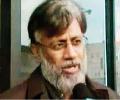
Pakistani-origin Canadian businessman Tahawwur Rana, sought for his involvement in the 2008 Mumbai terror attacks, has approached a US court for a status conference after waiting for an order on his extradition to India for more than 20 months.

Usman, said he hailed from Faislabad in Pakistan, and claimed he had entered Jammu 12 days ago.
A lawyer defending the seven Pakistanis, including Lashkar-e-Tayiba top commander Zakiur Rehman Lakhvi, accused of involvement in the Mumbai attacks on Monday claimed that a verdict against Ajmal Kasab would result in the dropping of the main charge against his clients.
Pakistani-American terrorist David Headley, who confessed to plotting the Mumbai terror attacks, had a dual personality that enabled him to switch between a Westerner and a devout Muslim and evade suspicion, according to his maternal uncle. "It could not have been more different between the two worlds. In one world, where he wants to be Pakistani, he was considered to be an American. With Americans, he was being seen as a Muslim. So he had to get used to a duality of life."
David Headley's latest revealations show the extent of the Pakistani army's involvement in formenting terror in India. Headley said that when he was training with the Lashkar-e-Tayiba, there were six Pakistani army officials who were directly involved in helping the LeT carry out terror strikes in India.
Pakistani-American terrorist David Headley's plea bargain, under which he confessed to plotting the Mumbai terror attacks, throws light on close links between the Al Qaeda and the Lashkar-e-Tayiba, according to former Central Intelligence Agency expert Bruce Riedel.Headley's story showed in clear contours the close relationship between Al Qaeda and the Pakistani militant group LeT, Riedel, who led the review of the Obama administration's Af-Pak strategy,said.
It has been two years since the horrific 26/11 attacks shook Mumbai and India, but there are still plenty of lose ends in the case thanks to the fact the Pakistani spy agency Inter Services Intelligence and Lashkar-e-Tayiba relied on operatives from around the globe to execute the dastardly attacks, reports Vicky Nanjappa.
A Pakistani court conducting the trial of seven suspects charged with involvement in the 2008 Mumbai attacks on Saturday adjourned proceedings till September 25 after summoning five prosecution witnesses to testify at the next hearing.
'When one speaks to Indian intelligence officials, they will tell you "We actually have a better understanding of Pakistani groups than we have of our own indigenous networks".'

Identifying Lashkar-e-Tayiba as the most problematic of the terrorist groups inside Pakistan, a top United States intelligence official has warned that the outfit has the long-term potential to become like Hamas or Hezbollah.
The LeT activist, who was caught in a third country, has admitted to his complicity in the Hyderabad blast and he was subsequently deported to Pakistan.

Lashkar-e-Tayiba (LeT) terrorist Talib Hussain Shah was briefly associated with a political party and also posed himself as a media-person, Jammu and Kashmir Director General of Police (DGP) Dilbag Singh said on Monday.
Sympathies for the Lashkar-e-Tayiba, the group involved in Mumbai carnage, and its jihadist and anti-India culture run deep in the Pakistani establishment, raising a serious challenge to any long-lasting move to dismantle the terror network.
